
Reducing nutrient emissions from agriculture
We will significantly reduce nutrient emissions from agriculture, and influence legislation to further decrease this nutrient load.
Pellon perintö
Agri- and culture project
The Agri- and culture project supports the objective of the Finnish Government’s Archipelago Sea programme: to reduce diffuse pollution in the Archipelago Sea drainage basin, so that the region can be removed from the Baltic Marine Environment Protection Commission’s (HELCOM) list of the worst pollution hotspots by 2027 at the latest.
Our activities focus on the Uskelanjoki River drainage basin, where we are working to reduce nutrient runoff from agriculture and carrying out participatory and community-oriented cultural projects.
In 2025, we worked with farmers
- We promoted the use of soil conditioners.
- We established new shelterbelts, and increased vegetation cover during the winter months.
- We improved surface water management in fields by reshaping the field surface.
Cultural work in 2025
- We invited local communities to share their experiences and stories about the Uskelanjoki River.
- We organised events in collaboration with local communities.
- We developed a series of courses with Salo Adult Education Centre to support the project’s objectives.
GYPREG
Tackling agricultural phosphorus load by soil amendments (GYPREG) is a project that aims to reduce eutrophication in the Baltic Sea by promoting the gypsum treatment of fields in Latvia, Lithuania, Poland, Sweden and the Åland Islands, as this has been proven to be effective.
In 2025
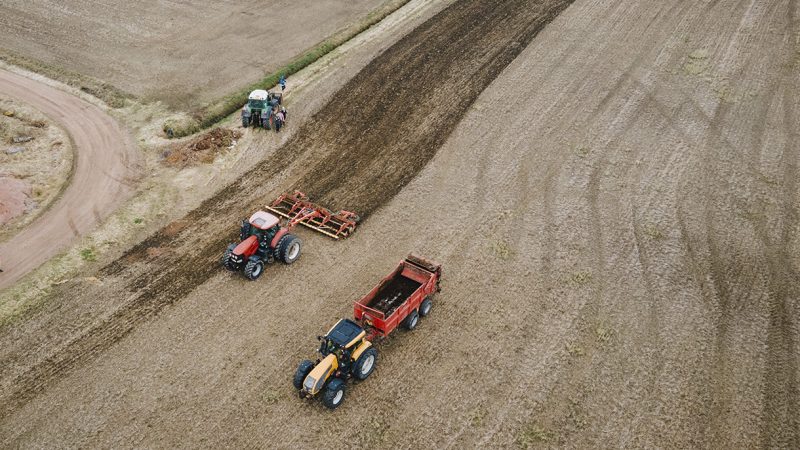
- We spread gypsum over 108 hectares of arable land in the Åland Islands.
- We developed a national operating model for carrying out gypsum treatments in collaboration with farmers, authorities and other key stakeholders.
- We gathered information about the potential for carrying out gypsum treatments in the Åland Islands.
- We are also promoting gypsum treatments by taking part in the Finnish Environment Institute’s NordGypsum project (Denmark & Norway) and the University of Klaipeda’s ECONUT project (Lithuania).
Similar measures were implemented in other project countries by the Finnish Environment Institute, Latvian Institute of Aquatic Ecology, Latvian Farmers’ Parliament, Lithuanian Research Centre for Agriculture and Forestry, Research Institutes of Sweden, Race for the Baltic (Sweden), and the Institute of Technology and Life Science (Poland).
The project is being co-funded by EU Interreg Baltic Sea Region.

Photo: Tara Jaakkola