Daily life aboard a marine research vessel
Text:
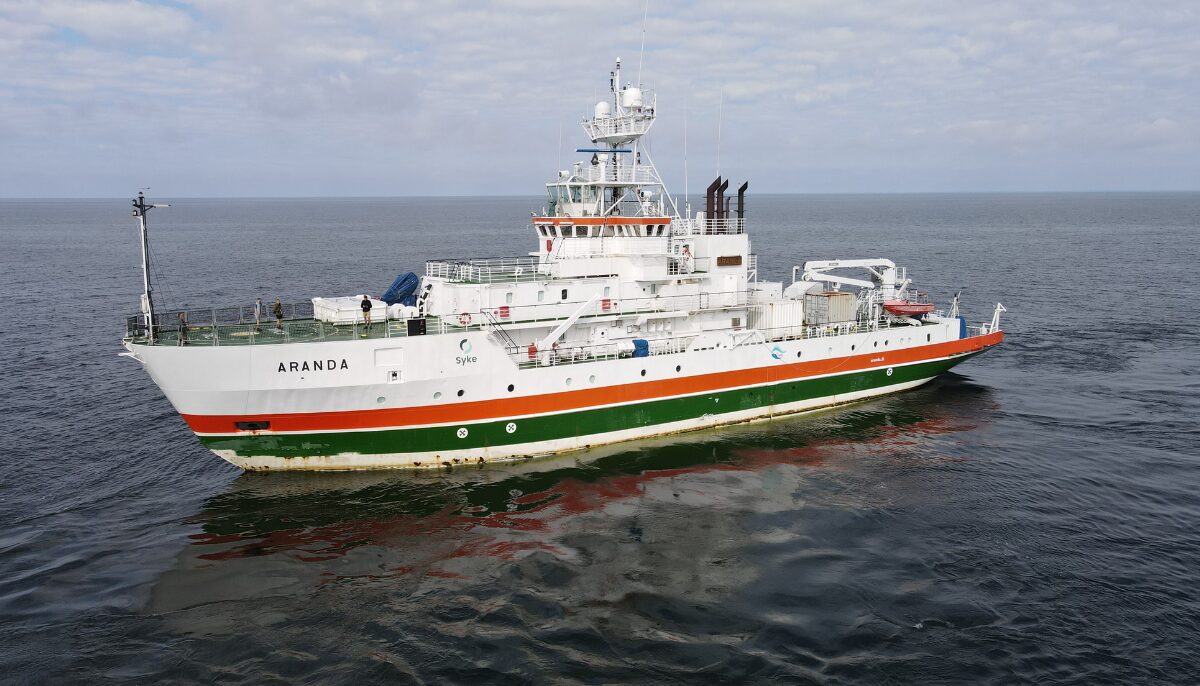
You have to move quietly along the cabin corridor on the marine research vessel Aranda: someone is probably asleep, as the ship’s crew work around the clock. The Aranda’s 14 crew members, along with a similar number of scientists, work in a variety of roles to ensure the smooth collection of data about the state and characteristics of the Baltic Sea.
It is pouring with rain when I arrive at the Aranda’s quay. I am about to board the marine research vessel when an employee on the rear deck asks me to stop. They are handling something with the deck crane, which means I cannot go on deck without safety equipment. I feel the weight of my helmet and safety shoes at the bottom of my rucksack.
Once I get permission, I carefully cross the bridge to the boat. The rain has done its job, and the deck is slippery.
Good food, better mood
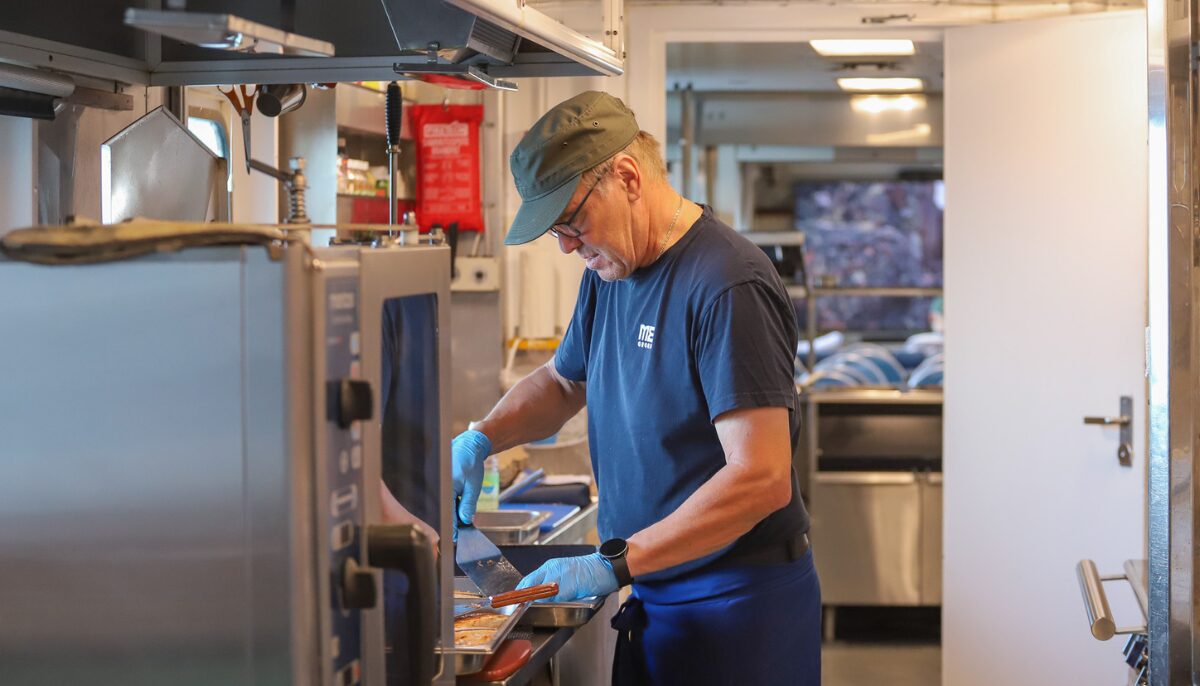
We sit down at the mess table with the Aranda’s cook, Hannu Laine. The mess is the ship’s communal lounge and dining area, where people also assemble in the event of an emergency.
Now is a good time to talk, as Laine has not started making dinner yet. Meal times are strictly adhered to. Schedules are important at sea to ensure that all crew members can take their scheduled breaks and rest. Meals bring everyone away from their work and around a communal table. Food is important – in all weathers.
“I have been out on the water in pretty good conditions, although it can be a bit rough sometimes. Cooking can then be something of a challenge, but people need to eat. It is important to keep everyone happy when on board a ship,” says Laine.
Laine, who comes from Turku, says that he has never once regretted his decision to work at sea. But the Aranda is not his first ship. He has previously sailed on, for example, Kristina Cruises vessels, which have taken him all around the world.
A kitchen with good sea views
“Do not be alarmed – potatoes should be boiled in water that is as salty as the Mediterranean Sea,” says Laine, as he pours salt into a large pan.
There is a kitchen island in the centre, complete with hobs and taps, and above which hang ladles and other kitchen utensils of various sizes. And behind a small hatch at the back of the kitchen, a lift carries food and water bottles up from the downstairs storerooms.
Laine makes the ship’s food orders, that is, decides what will be served at sea. He is responsible for preparing the main courses for lunch and dinner. Other meals and side dishes are prepared by the ship’s other cook.
A lot of food is consumed on board – in fact, everything that is served. Laine says he is making more vegetarian dishes than before. The vegetarians onboard have given him plenty of tips for tasty plant-based proteins.
Continuous maintenance
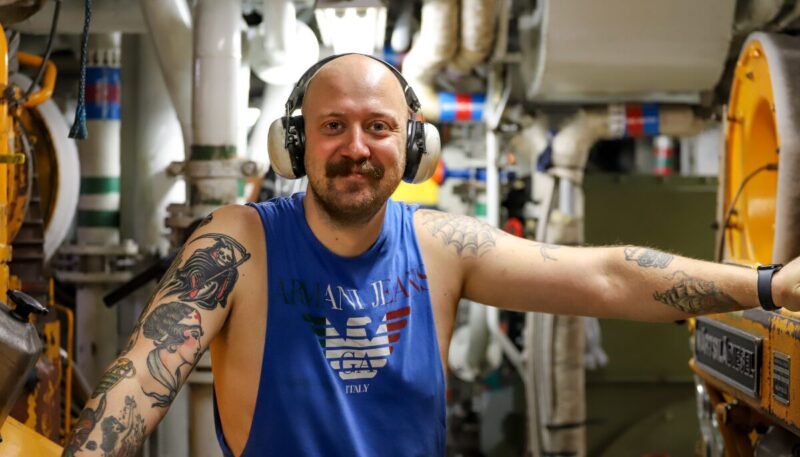
A steep spiral staircase leads down to the ship’s engine room. Samuel Laine, the Aranda’s repairman hands us hearing protectors before we enter.
The engine room is hot and noisy. There are numerous unexpected obstacles for you to bump your head on. The contours of the ceiling are lined with wires, with new layers continuously being laid on top of old ones. The space is shrinking. Although the Aranda is getting on a bit, the ship has similar technology to newer vessels.
Samuel Laine has been working on the Aranda since 2018. He spends about five months a year on board doing intensive periods of work.
Before joining the Aranda, Laine sailed on several other seas – on ships carrying bulk cargo such as cereals. Working at sea has taken him to every coastal state around the Baltic Sea, although he may only spend a short time at the destination itself.
“I sometimes get jealous of my friend’s business trips to Spain, but then again, you do not get to see much during those short stays either,” he says.
Plastics from the air and sea
The Aranda is an ice-class marine research vessel – the only one of its kind in the Baltic Sea. It can therefore conduct Baltic Sea research during the winter, and even in challenging ice conditions. The Aranda has also visited Arctic and Antarctic regions.
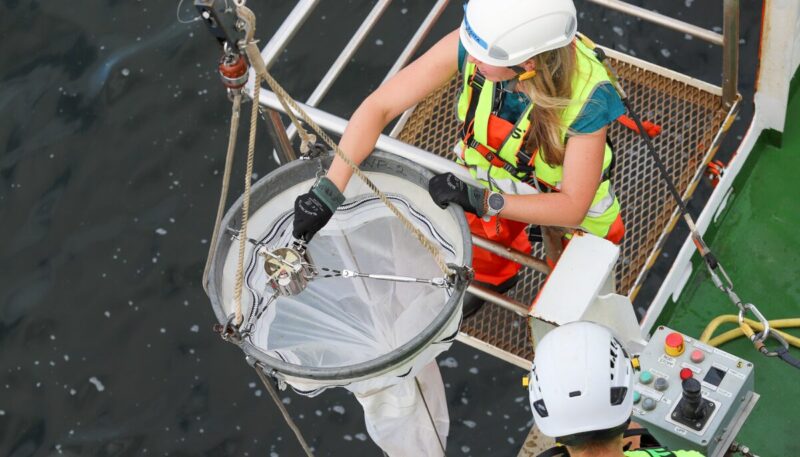
The ship carries a broad range of measuring equipment for marine research and monitoring: the biological, chemical and physical properties of the sea are measured during the voyage, along with harmful substances. In addition to researchers carrying out surveillance monitoring, there may also be university researchers aboard.
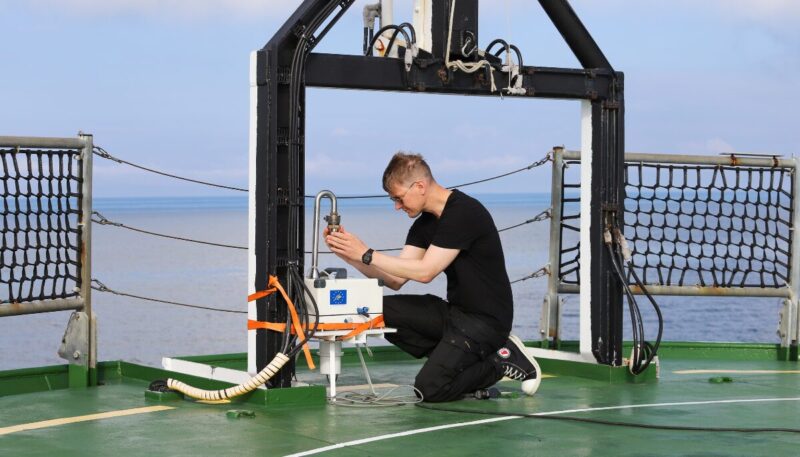
Arto Hiltunen, a nanoplastics researcher from the University of Turku, has joined this August’s trip. He is collecting samples both from the air and at different depths in the sea. These samples will be analysed later in a laboratory on land. Nanoplastics are tiny particles that are invisible to the eye. Little is known about their distribution and effects on human health.
He measures air concentrations using a device that is mounted on the ship’s bow, which “hoovers up” the air. These samples include soot and pollen as well as nanoplastics. “Based on the winds, computer models can be used to calculate where the plastics are coming from. Plastic can travel long distances, in the same way that sand from the Sahara and smoke from Canada have made their way to Finland,” says Hiltunen.
Many maritime roles
While someone on the Aranda is welding a stuck hatch, someone else will be comparing zooplankton samples in the lab. All these different roles enable a common mission: the smooth monitoring of the state of the sea. Data which can later be used to plan conservation measures.
At 9 pm, a few employees come to the mess for their evening meal. Some have just been to the sauna, while others are taking a break from their work. The TV is showing the evening news. Yet your gaze occasionally drifts to the horizon beyond the window, painted in various shades of orange by the setting sun. Although the news takes us through the twists and turns of international politics, the sea refuses to be forgotten.
Aranda is a marine research vessel administrated by the Finnish Environment Institute.
The Aranda brings worrying news about the state of the Baltic Sea